TIN Format: BIR Tax Identification Number Structure
Your Tax Identification Number is more than just a random string of digits. Every number in your TIN follows a specific structure set by the Bureau of Internal Revenue, and knowing that structure helps you verify your TIN correctly, avoid errors on tax forms and official receipts, and spot a fake or incorrectly formatted TIN immediately.
The standard TIN format in the Philippines for individual taxpayers consists of nine digits written in three groups of three, separated by hyphens.
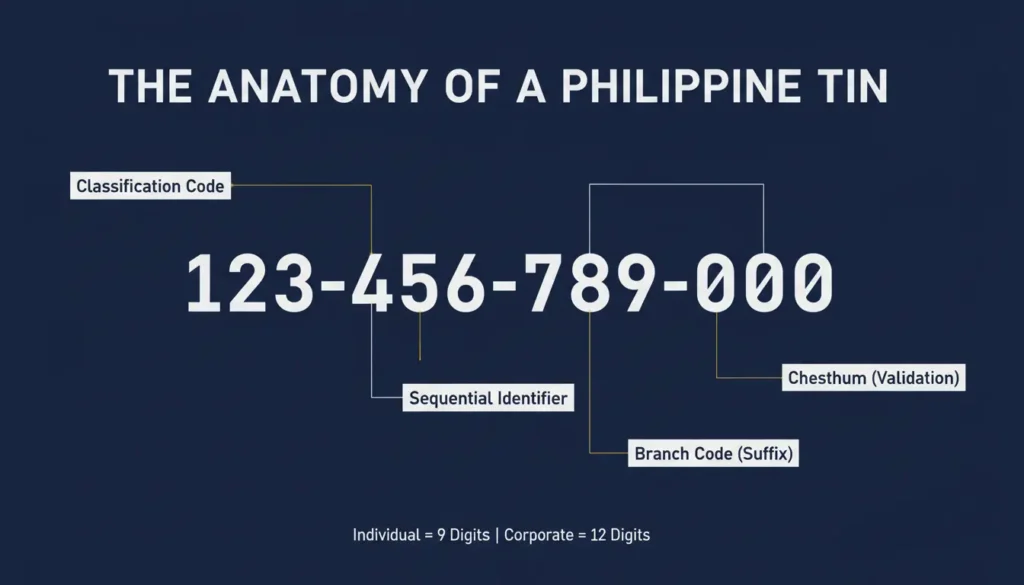
Anatomy of a TIN
123 seg 1
Classification Code
0 = Corporation, 1–9 = Individual taxpayer category.
456 Seg 2
Sequential Identifier
Your unique BIR registration sequence number.
789 Seg 3
Checksum Digit
Mathematical derivation for validation (NIRC §236).
000 Seg 4
Branch Code Suffix
000 = Head Office, 001+ = Branch locations.
9-Digit VS 12-Digit TIN Format
9-Digit TIN Format
XXX–XXX–XXX
Standard Individual / Freelancer
Assigned to individual taxpayers, self-employed professionals, and freelancers upon registration.
12-Digit TIN Format
XXX-XXX-XXX-000
Corporations & Branch Offices
Includes a 3-digit branch code suffix. Head offices always end in 000.
Branch Code Reference
The 3-digit suffix identifies the specific office or branch for corporate TINs.
000
Head Office: Default suffix for all primary registrations
001
First Branch Office: First registered branch
002
Second Branch Office: Second registered branch
003
Third Branch Office: Continues sequentially
—
Subsequent Branches: Up to 999 possible branches
Pro Tip: A corporation’s head office always ends in 000. If you see a different suffix, it’s a branch registration.
TIN Formats by Taxpayer Type
Different taxpayer categories follow specific TIN format conventions.
Taxpayer Type | TIN Format | Example |
|---|---|---|
Individual employee | 9 digits | 123-456-789 |
Freelancer / self-employed | 9 digits | 123-456-789 |
Licensed professional | 9 digits | 123-456-789 |
Sole proprietor (single location) | 9 digits | 123-456-789 |
Sole proprietor (multiple branches) | 12 digits | 123-456-789-001 |
Domestic corporation (head office) | 12 digits | 123-456-789-000 |
Domestic corporation (branch) | 12 digits | 123-456-789-001 |
Partnership | 12 digits | 123-456-789-000 |
Government agency | 12 digits | 123-456-789-000 |
Non-resident foreign corporation | 12 digits | 123-456-789-000 |
EO 98 / one-time transaction | 9 digits | 123-456-789 |
Format Evolution Timeline
How the Philippine TIN system has evolved over six decades of tax administration.
1965
Legacy
Tax Account Number (TAN)
Alphanumeric format introduced under the original National Internal Revenue Code. Complex and error-prone.
1998
Modernization
Standard 9-Digit Numeric TIN
Integrated Tax System (ITS) launches the modern numeric TIN. Simplified registration and compliance nationwide.
2023
RMC 121-2023
Digital TIN ID with QR Code
Revenue Memorandum Circular 121-2023 introduces the standardized digital TIN ID with scannable QR verification.
2026
Current
Full Digital Integration
ORUS portal mandates digital-first TIN verification. RA 12023 compliance ensures seamless e-governance.
TIN Format for Foreign Nationals in the Philippines
Foreign nationals transacting in the Philippines receive a TIN following the same 9-digit numeric format as local taxpayers. However, the first digit of a foreign national’s TIN is typically assigned from a specific range in the BIR’s coding system to distinguish it from Filipino taxpayer TINs.
Foreign nationals who are employed in the Philippines receive their TIN through their employer or by applying directly at their assigned RDO or through ORUS using BIR Form 1904. Non-resident foreign corporations registering for VAT compliance under RA 12023 receive a 12-digit corporate TIN with the 000 head office branch code.
Where Your TIN Appears
BIR Form 2303
Certificate of Registration (COR)
Your primary proof of BIR registration, displaying your full TIN.
Official Receipts
Sales Invoices & Receipts
Required to be printed on all official receipts and sales documents.
BIR Form 2307
Withholding Tax Certificate
Shows your TIN for creditable tax withheld from income payments.
Income Tax Returns
ITR Forms 1700 / 1701 / 1702
Pre-printed on annual income tax return filings submitted to BIR.
TIN Format Validation Through ORUS
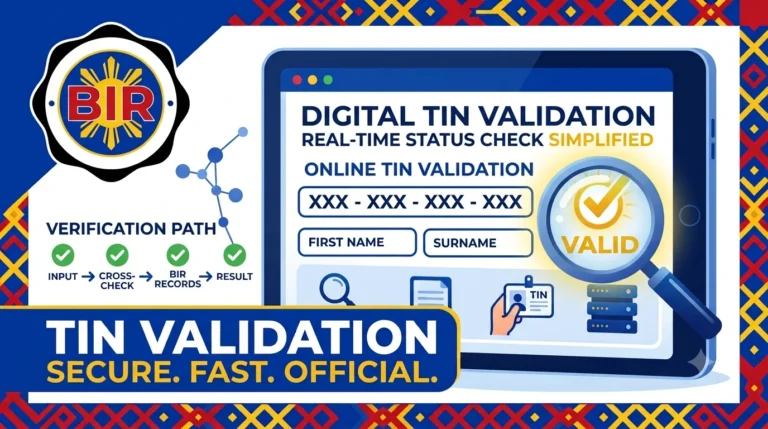
The ORUS system at orus.bir.gov.ph includes a built-in TIN format validation feature. When you enter a TIN on any ORUS form or the TIN Verification Tool, the system automatically checks:
If your TIN fails any of these checks, ORUS displays a validation error before allowing you to proceed. This prevents the submission of incorrectly formatted TINs on official BIR applications.
FAQs
Conclusion
The Philippine TIN format is straightforward once you understand its structure. Individual taxpayers use a 9-digit format written as XXX-XXX-XXX, where the first three digits classify the taxpayer type, the middle digits are a unique sequential identifier, and the final digit is a checksum for validation. Corporations and businesses with multiple branches extend this to a 12-digit format by adding a three-digit branch code suffix, with 000 for the head office and sequential numbers for each additional branch.
Getting your TIN format right matters every time you fill out a BIR form, issue an official receipt, file a tax return, or present your Digital TIN ID for verification. A single misplaced digit can trigger validation errors on ORUS, cause document rejections, or raise red flags during a BIR audit.