BIR Form 2305: Purpose, Requirements, and Step-by-Step Filing
Managing employment records in the Philippines involves several tax compliance procedures. Whether you are switching companies, getting married, or welcoming a new child, keeping your taxpayer profile updated with the Bureau of Internal Revenue (BIR) is mandatory.
One of the most frequently referenced tax documents for employed individuals is BIR Form 2305, officially known as the Certificate of Update of Exemption and of Employer’s and Employee’s Information.
What is BIR Form 2305?
BIR Form 2305 is an official tax update document designed for individual compensation earners (employees) to notify the BIR and their employers of changes in their tax registration details, personal information, and employment status.
When an individual changes jobs, accepts secondary employment, or needs to reconcile employer records, this form serves as the formal declaration establishing the withholding tax relationship between the employee and the withholding agent (employer).
The Impact of the TRAIN Law on BIR Form 2305
To understand how BIR Form 2305 is used today, it is essential to look at the legislative changes introduced by the Tax Reform for Acceleration and Inclusion (TRAIN) Law (Republic Act No. 10963).
1. Elimination of Personal and Additional Exemptions
Prior to the TRAIN Law, Filipino taxpayers were granted:
Under that legacy regime, filing BIR Form 2305 was critical every time a worker got married or had a child, as each change directly modified their monthly withholding tax deduction table.
2. The ₱250,000 Universal Exemption Bracket
The TRAIN Law simplified individual taxation by replacing graduated personal exemptions with a universal zero-percent (0%) tax rate on annual taxable income up to ₱250,000.
3. What It Means for Taxpayers Today
While individual personal exemptions for dependents are no longer factored into standard payroll withholding tax computations, updating your taxpayer profile remains an essential legal obligation. BIR Form 2305 (alongside BIR Form 1905) continues to serve as an administrative mechanism for tracking employer-employee links, multiple employments, and vital taxpayer identity records.
BIR Form 2305 vs. Form 1905 vs. Form 1902
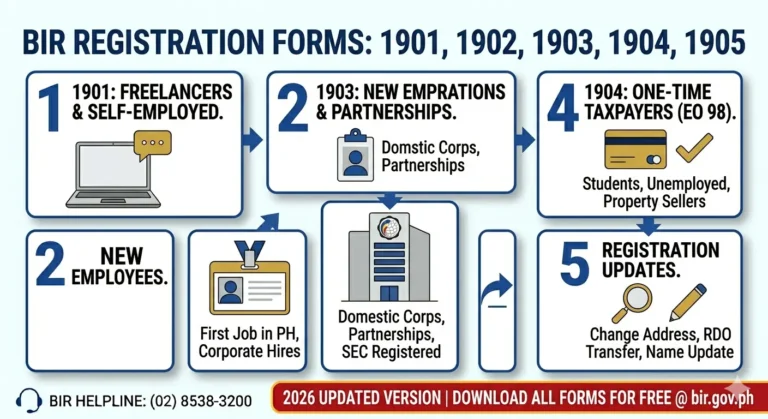
Taxpayers and human resource personnel often confuse the primary individual tax registration forms. Here is a comparison to clarify which form to use:
Feature / Scope | BIR Form 2305 | BIR Form 1905 | BIR Form 1902 |
|---|---|---|---|
Primary Title | Certificate of Update of Exemption & Employer/Employee Info | Application for Registration Information Update / Correction / Cancellation | Application for Registration for Individuals Earning Purely Compensation Income |
Primary User | Existing employed taxpayers updating employment connections | Any registered taxpayer (individual, business, corporate) | First-time employees acquiring their very first TIN |
Core Function | Updating employer details, multiple employment status | Transferring RDO, correcting misspelled names, changing civil status | Initial registration and TIN issuance under an employer |
Submission Point | HR Department / Assigned RDO | The taxpayer’s currently registered RDO | Employer’s registered RDO / BIR ORUS portal |
Who Needs to Accomplish BIR Form 2305?
Filing or updating Form 2305 is necessary in several standard employment situations:

Existing TIN Holders
New hires with an existing TIN from a previous job whose new employer needs to link their profile.
Successive Employments
Workers who transitioned between multiple employers in a single calendar year requiring tax consolidation.
Concurrent Employments
Individuals working simultaneously for two or more employers who designate a primary withholding agent.
Civil Status Changes
Employees updating legal surnames following marriage, legal separation, or official record corrections.
Key Sections of BIR Form 2305 Explained
BIR Form 2305 consists of several distinct sections. Reviewing each part ensures accuracy before submitting the document:
Part I: Taxpayer/Employee Information
Part II: Personal Information and Civil Status
Part III: Declaration of Dependents
Contains fields for listing children or qualified legal dependents, birth dates, and any physical or mental incapacities. Used primarily for demographic profiling and record verification.
Part IV: For Employees with Multiple Employers
Part V: Employer Information
Documentary Requirements Checklist
To file BIR Form 2305 smoothly, assemble the appropriate primary and secondary supporting documents:
Mandatory Submission Checklist
How to Fill Out and Submit
Follow these sequential steps to complete and submit the form accurately:
Digital Alternatives: ORUS and Electronic Tax Updates
Under the BIR’s digital transformation roadmap and the Ease of Paying Taxes (EOPT) Act (RA 11976), taxpayers can complete many traditional manual updates through digital channels:
Online Workflow: Log in to the BIR ORUS Portal (orus.bir.gov.ph), navigate to Registration Information Update, select your modification category, upload PDF scans of supporting documents, and receive your electronic acknowledgement reference.
Deadlines and Compliance Rules
Common Mistakes to Avoid
Mistake | Impact |
|---|---|
Using an Incorrect TIN | Tax records fail to credit properly; payroll withholding errors |
Failing to Disclose Previous Employers | Inaccurate year-end annualized tax calculations resulting in large tax payables |
Submitting Without Employer Signatures | Automatic rejection by the BIR receiving counter |
Neglecting RDO Transfers | Record mismatches between your residential RDO and your employer’s RDO |
FAQs
Conclusion
Keeping your BIR Form 2305 updated is a vital step in maintaining clean tax records and ensuring hassle-free payroll operations throughout your career. While the TRAIN Law simplified personal exemption brackets, keeping your employer linkages, civil status, and personal data accurate protects you from unexpected tax discrepancies, misallocated withholdings, and year-end filing delays.