BIR Form 0605: Payment Form Purpose, Tax Codes, and Filing Process
Navigating tax obligations with the Bureau of Internal Revenue (BIR) involves filing standard tax returns such as monthly percentage taxes, quarterly VAT, and annual income tax returns. However, situations frequently arise where a taxpayer must remit payments, settle penalties, pay deficiency assessments, or make advance deposits that do not correspond directly to a regular tax return form.
In these circumstances, the prescribed document is BIR Form 0605, officially known as the Payment Form.
What is BIR Form 0605?
BIR Form 0605 is a multipurpose payment voucher used by individual and corporate taxpayers in the Philippines to pay taxes, fees, and penalties that do not require a separate, dedicated tax return.
Unlike declarative returns (such as Form 1701 for Income Tax or Form 2551Q for Percentage Tax), Form 0605 does not calculate taxable gross receipts or deductions. Instead, it serves as an official remitting vehicle that links a specific monetary payment to your Taxpayer Identification Number (TIN), tax type, and taxable period in the BIR’s Integrated Tax System (ITS) and Internal Revenue Integrated System (IRIS).
Major Policy Update: The Ease of Paying Taxes (EOPT) Act
For decades, the most common reason micro, small, and corporate taxpayers filed BIR Form 0605 was to pay the mandatory ₱500 Annual Registration Fee (ARF) on or before January 31 of every calendar year.
CRITICAL TAX COMPLIANCE UPDATE
(RA 11976 / EOPT)
Under Republic Act No. 11976 (Ease of Paying Taxes Act), implemented via Revenue Memorandum Circular (RMC) No. 14-2024 and Revenue Regulations (RR) No. 11-2024:
While the recurring January registration fee filing has been eliminated, BIR Form 0605 remains an active, critical form for various other tax compliance requirements.
When Do You Need to Use BIR Form 0605?
Taxpayers are required to use Form 0605 across several operational, administrative, and audit-related scenarios:
Payment of Tax Audit Deficiencies
When your business undergoes a tax investigation under an electronic Letter of Authority (eLA) or Subpoena Duces Tecum, the BIR will issue formal assessment notices if deficiencies are uncovered (Notice of Discrepancy, PAN, FAN/FLD, FDDA). To pay the agreed-upon basic tax deficiency along with accrued interest and compromise penalties, you must use Form 0605.
Settling “Open Cases” and Late Filing Penalties
If you missed a filing deadline for a quarterly or monthly return, or failed to submit an attachment (such as the SLSP), your profile will flag an “Open Case”. When settling these administrative compromise penalties at your Revenue District Office (RDO), you will be instructed to file Form 0605.
Paying the 2nd Installment of Income Tax
Under the Tax Code, individual taxpayers filing Form 1701 or 1701A whose total tax due exceeds ₱2,000 may opt to pay in two equal installments. The first is paid on or before April 15, and the second installment is paid on or before October 15 using BIR Form 0605.
TCVD Violations & Advance Deposits
Fines incurred during spot tax-mapping operations (TCVD) for minor infractions (e.g., failure to update manual books of accounts) or voluntary advance tax deposits / DST payments not covered by Form 2000 are remitted using Form 0605.
Key Tax Types and Alphanumeric Tax Codes (ATC) for Form 0605
When completing Form 0605, you must select the appropriate Tax Type and Alphanumeric Tax Code (ATC). Choosing the wrong combination may cause the BIR system to misallocate your payment.
Common Tax Type Codes
Tax Code | Tax Description | Applicable Scenario |
|---|---|---|
IT | Income Tax | Deficiency income tax, 2nd installment payments |
VT | Value-Added Tax | Deficiency VAT resulting from audit or late filing |
PT | Percentage Tax | Non-VAT business deficiency or penalty settlement |
WE | Withholding Tax – Expanded | Unremitted expanded creditable withholding tax |
WC | Withholding Tax – Compensation | Deficiency withholding tax on employee salaries |
DS | Documentary Stamp Tax | Unpaid DST on leases, mortgages, or contracts |
MC | Miscellaneous Tax | Administrative compromise penalties, TCVD fines |
Frequently Used ATCs on Form 0605
ATC | Description | Specific Usage |
|---|---|---|
FP | Full Payment | Used when paying deficiency taxes upon assessment or notice |
AP | Advance Payment | Advance tax deposits or voluntary pre-payments |
II | Installment Payment | Specifically used for the 2nd installment of Income Tax |
MD | Miscellaneous Deficiency | General penalty settlements and administrative fines |
MC180 | Registration Fee (Historical) | Formerly used for the ₱500 Annual Registration Fee (now abolished) |
How to Fill Out BIR Form 0605 via eBIRForms
The BIR requires all non-eFPS taxpayers to prepare their tax returns using the Offline eBIRForms Package.
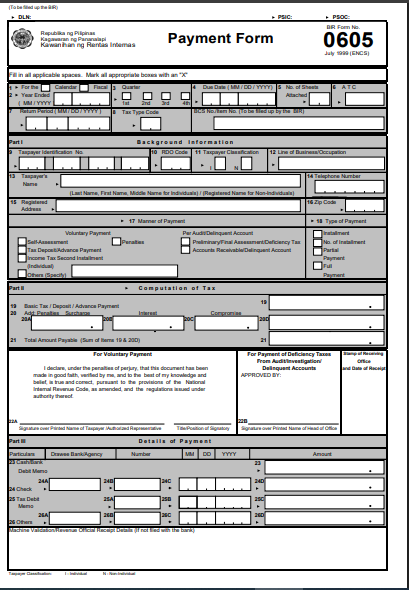
Sample Configuration: Settle Income Tax 2nd Installment
How to Pay BIR Form 0605
Under the Ease of Paying Taxes (EOPT) Act, taxpayers can remit tax payments at any Authorized Agent Bank (AAB) or through authorized online portals nationwide, removing previous jurisdictional venue restrictions.
Channel | Best For |
|---|---|
Authorized Agent Banks (AAB) | Large corporate sums, audit checks |
LANDBANK Link.BizPortal | ATM, BancNet, LandBank account holders |
DBP PayTax Online | Visa/Mastercard credit/debit cards |
Mobile Wallets (GCash, Maya) | Small settlements, penalties < ₱50k |
eFPS Facility | Enrolled large taxpayers |
Method 1: In-Person at an Authorized Agent Bank (AAB)
Print three (3) copies of the accomplished Form 0605 along with the eBIRForms email confirmation. Fill out the bank’s BIR Tax Deposit Slip, present the forms and payment (cash or manager’s check) to the teller, and secure your machine-validated receiving copy.
Method 2: Online via Electronic Payment Gateways
Log in to your preferred payment application (GCash, Maya, LandBank Link.Biz), navigate to Pay Bills > Government > Bureau of Internal Revenue, select Form Series 0600 (Form 0605), enter your 9-digit TIN, Branch Code, Tax Type Code, and Return Period, then complete payment and save the digital receipt.
Common Mistakes When Filing Form 0605
FAQs
Conclusion:
Understanding how to properly file and remit payments through BIR Form 0605 is essential for maintaining clean tax records and avoiding compounding interest, open cases, and costly audit penalties. While the Ease of Paying Taxes (EOPT) Act successfully removed the recurring January annual registration fee, Form 0605 remains an indispensable mechanism for settling audit assessments, remitting secondary income tax installments, and paying compromise penalties.
By verifying your tax type codes, submitting forms accurately through eBIRForms, and leveraging accredited online payment channels, both individuals and business owners can resolve tax obligations efficiently and maintain full compliance with the Bureau of Internal Revenue.